When you buy through links on our articles, Future and its syndication partners may earn a commission.

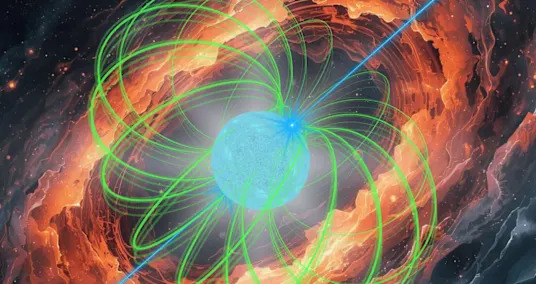
Astronomers have discovered that rapidly spinning dead stars called neutron stars at the heart of pulsars can blast out radio signals from their edges. The finding could overturn decades of thinking suggesting that pulsars only blast beams of radiation from close to their surfaces and at their poles.
Pulsars, like all neutron stars, are created when massive stars run out of fuel needed for their internal nuclear fusion process and thereby collapse, forming a stellar remnant with matter so dense that if a teaspoon of it were brought to Earth, it would weigh around 10 million tons. This collapse also generates the universe's most powerful magnetic fields — and, like the cosmic equivalent of an ice skater drawing in their arms to increase their speed, the collapse can also speed up the spin of neutron stars to as much as 700 times a second.
When these rapidly spinning neutron stars blast out radiation from their poles, that radiation sweeps across the cosmos like beams of light from a cosmic lighthouse. And it is these cosmic lighthouses are known as pulsars. In fact, the rotation rate of pulsars are so accurate and well-regulated that they can be used as highly precise universal "clocks."
The team behind the new research examined radio observations of around 200 rapidly spinning pulsars, or millisecond pulsars, comparing them to data collected in gamma-rays. This revealed radio waves emanating from two or more regions surrounding around 33% of these millisecond pulsars. Only 3% of slower-rotating neutron stars have been observed to emit radio waves from a region within their grasp besides their poles.
Then the fact that the more distant radio wave pulses aligned with gamma-ray blasts from these pulsars detected by NASA's Fermi Space Telescope indicated to the team that both types of electromagnetic radiation were being emitted from the same non-polar and distant regions around these pulsars.
"As we are detecting signals both from the stars' surfaces and from the very edge of their magnetic reach, this study shows that these tiny, fast-spinning stars are even more complex and surprising than we thought," team member Simon Johnston from Australian science agency CSIRO (Commonwealth Scientific and Industrial Research Organisation) said in a statement.

The team concluded that these factors indicate millisecond pulsars produce radio waves close to the poles of these dead stars and in a swirling "current sheet" of charged particles — that are more distant from the neutron star and beyond its magnetic fields — which sweep around with the motion of the dead star.
Current sheets were already known to be responsible for the gamma-ray emission of millisecond pulsars, so the alignment between radio waves and gamma-rays indicates a shared origin point.
This could also explain why some millisecond pulsars have strange, broken-up radio wave profiles. What astronomers observe, be it radio waves from the poles, from the current sheet, or both, depends on how the pulsar is oriented in relation to our telescopes.
One useful outcome of this research and its findings is the fact that millisecond pulsars should be easier to detect than astronomers had previously theorized. That's because the radio waves are emanating over a wider range of directions rather than just in a narrow cone from the poles. That means a pulsar doesn't have to be perfectly aligned with Earth to be observed via its radio emissions.
While this is good news for projects such as the measurement of ripples in spacetime called gravitational waves that use large arrays of pulsars, the team is still puzzled about how radio pulses can be generated so far away from neutron stars and the turbulent immediate environments they generate.
"Understanding where their signals come from — and why they look the way they do — is essential for using them as precision instruments," team member Michael Kramer from the Max Planck Institute for Radio Astronomy (MPIfR), Germany, said in the statement.
The team's results were published on March 25 in the journal Monthly Notices of the Royal Astronomical Society.
latest_posts
- 1
 Which sandwich do you find totally delectable? !
 - 2Winter virus season so far is not too bad, but doctors worry about suffering to come
- 3Brazil's Bolsonaro to continue his sentence at home because of poor health
- 4Netflix’s Price Hikes Just Got Rejected by an Italian Court. Here’s Why It Matters Everywhere
- 5Five EU states press for windfall taxes on fossil energy sector





- I’m a neuroscientist who taught rats to drive − their joy suggests how anticipating fun can enrich human life
- Avoid This Common Mistake When Planning Sightseeing Activities For Your Trip To Italy
- Falcon 9 rocket launches Starlink satellites before making 550th SpaceX landing (video)
- Wolf Bites Woman in Shocking Attack at Busy Shopping Center
- Delta flight bound for Atlanta makes emergency landing after engine issue
- The best ice packs for coolers of 2026, tested and reviewed
- Tech Patterns: Contraptions That Will Shape What's in store
- Believe Should Unwind? Look at These Scaled down Games
- EU health regulator urges immediate vaccinations amid early surge in flu cases