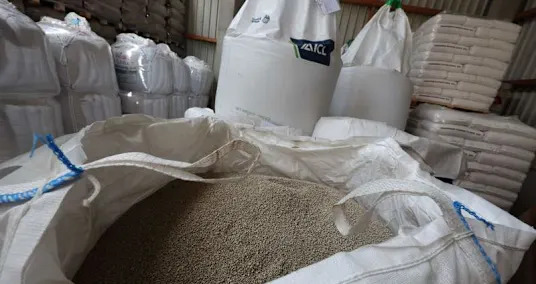

The war in Iran has resulted in a 30-40% spike in the cost of mineral fertilizer since the start of the year, threatening international food prices, according to German experts.
"World market prices for nitrogen fertilizer are increasingly approaching the peak levels we saw at the start of Russia's war against Ukraine [in February 2022]," said Philipp Spinne, managing director of the German Raiffeisen Association (DRV).
In Europe, however, consumers have not yet directly felt the effects because many farmers had already purchased their spring fertilizer before the Iran war began, the Bavarian Farmers' Association told dpa.
But should the war drag on, production costs in Germany and other countries are likely to rise, and with them, producer prices, it warned.
Four years ago, the threat to global food security feared by some experts did not materialize.
This was partly because Russia – a leading fertilizer producer – benefited from the invasion of its neighbour and actually increased its fertilizer exports.
The European Union has since gradually introduced tariff increases on Russian nitrogen fertilizers.
High energy prices are primarily driving the pricing spike, with gas prices accounting for up to 90% of the costs of ammonia and nitrogen production, said Germany's Agrar industry association.
Therefore, if gas becomes more expensive, fertilizer prices automatically rise. But if farmers use less fertilizer, crop yields suffer as a result.
latest_posts




 Forget 'Outer Banks.' These Gen Z-ers just want to watch 'M*A*S*H*' and 'Gilmore Girls.'
- Scientists document a death from a meat allergy tied to certain ticks
- NASA Artemis II tracker: Crew less than 60,000 miles from moon ahead of Monday flyby
- Shrewd Home Gadgets to Save Energy
- The most effective method to Succeed in Your Web based Advertising Degree: Procedures for Progress
- Golden satellite insulation sparkles during test | Space photo of the day for Dec. 30, 2025
- Display of Netanyahu's severed head 'incites public to murder PM', Likud says in official complaint
- Fossils unearthed in Morocco are first from little-understood period of human evolution
- Artemis II astronauts are more than halfway to the moon as they seek to break Apollo 13's record