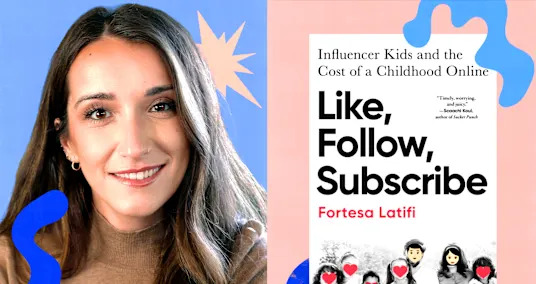
I’m not sure when I first became friends with Fortesa Latifi, but I’m positive it was because I admired her work. We’re both internet culture reporters covering the influencer realm, and in such an undercovered but zeitgeisty beat, you tend to become friendly with the people in the trenches with you.
Fortesa is one of the best to do it: she’s been reporting on the vastly unregulated parent and child influencer industry for years and has done much of the heavy lifting to start the conversation about this morally complex world.
Her debut book, Like, Follow, Subscribe: Influencer Kids and the Cost of a Childhood Online, is out April 7. Not only is it loaded with bombshells, but the revelations are laced together with incredible nuance and empathy from someone who also became a mom while deeply immersed in this subject. I scribbled exclamation points into the margins of nearly every page.
“I feel worse than I look,” Fortesa, now my colleague at Yahoo, tells me when we hop on a video call to talk about her book. She has a black and bloody eye, a wound from the hyperemesis gravidarum that she’s battling through her second pregnancy, which she announced just days earlier because it’s kind of hard to promote a book without addressing the eye thing.
We spoke extensively about the ethically wrought child influencer industry and the shocking things she learned while reporting Like, Follow, Subscribe.
Here’s our conversation, which has been edited for length and clarity.
There’s an ecosystem of influencers for every possible genre you could imagine. Why’d you decide to write about influencer kids specifically?
Childhood, adolescence and young adulthood are such vulnerable times. When I think about what it would be like to have all of that on the internet forever, it makes me feel sick to my stomach. You look at every other kind of influencer, and they made that choice to be online, right? For kid influencers, most of them didn’t make that choice. Their parents made that choice for them, and that complicates that entire situation.
Do you remember what story you wrote that started your journey on this beat?
I wrote a story for Teen Vogue about parent influencers and the kids who have had their childhoods made into content. I interviewed a young woman, who I call Claire, who grew up on a family vlogging channel. She told me that the YouTube channel was her family’s entire life, that when they were together, that’s what they talked about.
When I think about what it would be like to have all of that on the internet forever, it makes me feel sick to my stomach.
She first went viral as a toddler, and by the time I talked to her, she was a teenager. There was merch for sale with her face on it. Their YouTube channel had billions of views, and she wished that none of that had ever happened. She told me that if she could tell her parents one thing, she would say nothing they could do now can take back the years of work [she] had to put in. And that really stuck with me because I think it’s easy for people to think that influencing isn’t work and that content creation isn’t work. But it is! It’s quite laborious. I’m not saying it’s as hard as being a coal miner, but kids aren’t allowed to do that.
Early on in your book, you write, “These families open a window into their lives for us to peer through, and through that same opening money pours in.” In every single chapter, you outline this dynamic: People are exposing their lives and the lives of their children online, but they get so much money in return. When you started this book, did you think you’d be writing so much about money?
I don’t think I realized what a through line it would be, but when I think about it, what’s the point of doing all this other than money? There’s attention and community and acclaim, and all of that feels good. But no one would be doing this if it weren’t for the money. The crazy possibilities — the amount of money that’s possible — it’s so much. I talked to people who were making their entire previous year’s salary off of one brand deal. Well, no wonder they’re doing this, you know?
And it happens to so many demographics — the mom who knows one single post would pay for her boob job. The teen mom who wouldn’t be able to pay for things without social media. The trad wife who couldn’t work otherwise. It’s all about money, but everything’s about money, I guess!
People ask me all the time why anyone would do this, and I’m like, “Have you seen the possibilities of how much money you can make off of social media?”
You had a viral post about the shocking things that influencer kids told you for this book — what did they say to you and what was the response like?
I mentioned Claire, who also told me that her dad reminded her that even though he’s her dad, he’s also her boss and pressured her to stay on YouTube so the family could have “nice things.” Another young woman, Vanessa, was accused of not caring about her family’s livelihood when she didn’t show enough enthusiasm for vlogging. Her mom told her, “Do you want us to starve? Do you want us to not be able to make our payment next month on the mortgage?” And then there was this other former content kid, who, when I asked what their mom posted about them, said, “It’s easier to tell you what my mom didn’t post.”
In my mind, as a parent, your first allegiance is to your child and helping them and not helping other random people on the internet.
I think people were shocked to see not only that kids were having these experiences, but that they’re the age where they can tell a journalist about them. This has been going on for 20 years! For some people, it’s a confirmation of what they already thought, which is that these kids hate their lives. Some people have a more nuanced understanding of how this is really difficult — how a parent could keep getting closer and closer, then cross a line.
Another concept that really shocked me was just how much influencers told you that they firmly believe that posting about their lives could help someone. I get it — sometimes it does — but all of them believed this, that showing their children going through an intimate thing might help someone.
It’s a form of self-protection — because otherwise they would have to say, “I’m posting this to make money!” And that doesn’t feel good emotionally. So they have to say, “I’m posting this to raise awareness.”
I was personally jarred by how much people found that content with kids’ faces performs so much better than content without them. Videos about children’s pain and bad things happening to them perform well too. How did the influencers you talked to defend this to you?
They just see it as raising awareness, and that’s shocking to me because what does showing your kid having a tantrum or crying from teething — what does that show other moms? It doesn’t make sense to me. In my mind, as a parent, your first allegiance is to your child and helping them and not helping other random people on the internet.
I learned a lot about early mommy bloggers through your book, and one thing I found really surprising was how revolutionary it was to be honest about motherhood online in the 2000s. They really were raising awareness. So much of being an “influencer” back then involved being radically vulnerable and a really good writer.
I don’t think I understood until I started researching and writing this book that they were writers above all else. Before them, people weren’t really being honest about what birth was really like, or postpartum depression, or why you kind of hate your husband for a while after you have a baby. These women would write 4,000-word essays on infertility and miscarriages and the mental toll of potty training. In the beginning, it wasn’t even profitable. It was this precious thing that existed for the moms themselves and each other. I’m really jealous that I wasn’t a mom at that time because I feel like I can’t find that kind of content anymore.
Something else a lot of parent influencers use to justify putting their kids in this content is that the kids love being in it. That might be true, but they certainly don’t understand all of what’s involved in being a public figure.
My daughter would eat ketchup for every meal if I let her because she really likes it. That doesn’t mean it’s good for her. There’s no way for kids to understand the internet in a real way. One of the family vlogger parents that I talked to told me that sometimes kids don’t want to be in content, so they bribe them with cash. Families are making so much money that it doesn’t cost so much to give each kid $1,000.
I have to ask you about my favorite chapter — the one about Mormons and trad wives. You got this scoop about how the Mormon church pays its influencers. Tell me about that.
You wonder why so many influencers are Mormon, and I explain that in the book, but I found that the Mormon church actually compensates its influencers by giving them brand and sponsorship deals and bringing them together for networking. They realized a long time ago, before many other people did, the power of the internet. Only 2% of Americans identify as Mormon, but think about all the top influencers. Most of them are Mormon!
They’ve got to be earning that salvation!
They’re working for it, dude.
Society’s ethical response to parent influencers has changed so much over the last decade. Could you imagine putting an emoji over a child’s face, like, 10 years ago?
No, no one would do it! Even a year or two ago, it was kind of weird. Now, when people have kids — even regular, noninfluencers — there’s a question of whether or not they’ll show their kids online. I remember a few years ago, I had a relative who didn’t show her kid online, and I was like, “Who does she think she is?” Now I’m like, “Oh, word, she was right.”
I think a big part of the reason — from my interviews with those people and my own experience — is the incredible pace of AI developments. People are like, “I don’t want my kids in these AI databases! I don’t want people to be able to make deepfakes of them!” It’s so scary. It’s a technology that freaks me out and keeps me up at night.
Was there anything you learned from reporting this book that has stuck with you? There are so many to choose from, I know.
There was one conversation I had with a mom included in the book. She had an 8-year-old daughter, and she’s a family vlogger. Someone left a comment on one of her posts where they said, “I want to see under your daughter’s skirt.” It was obviously a pedophilic comment. I asked the mom what she did, and she said she blocked and reported him — and talked to her daughter about it. I was like, “How did that conversation go?” And she said, “There are dangerous people in the world. We got this comment about you, blah blah blah, you’re safe. We’ve got you.” She said her parenting philosophy is one of honesty and transparency. I guess I could understand telling an 8-year-old about this if it led to a greater conversation about not showing her as much online, but it didn’t lead to that. It was just, “We got this terrible comment about you.” That whole chapter is about parents who have taken their children off the internet. Some of them stay off, but some go right back on.
Your own experience with parenthood — you sold this book when you were pregnant with your first child, and it’s coming out as you’re pregnant with your second — is woven into your reporting with such tenderness and care. How did entering this phase of life while working on this book impact it?
It gave me incredible empathy for the parents but also incredible sensitivity to the children. Those two things seem to be at odds. When my daughter was born, I looked around and thought, “I would do anything on this planet to give her a good life.” In that way, I could look at the parents and say, I understand that they felt this was the best way they could give their children a financially stable life, which is really what we’re all trying to do.
At the same time, having my own child and looking at the content that gets posted of children when they’re sick or sad or getting potty trained or getting a sex talk or shaving their legs for the first time — it’s really difficult for me to understand why they’re being put out there that way. I kept ping-ponging — I understand this, but I can’t excuse it.
It also taught me the allure of these creators because when I had my first baby, I felt like my world stopped but the rest of the world kept spinning. The only people who reflected back to me that motherhood was the center of their universe were mom influencers and family vloggers.
Motherhood in America is incredibly isolating, even under the best circumstances. I famously live on the same block as my sister, I have a wonderful husband and my mom and mother-in-law take turns visiting us and taking care of us. We have a part-time nanny. I’m set, right? But I felt so alone. Sometimes the way I felt less alone was when I opened my phone and saw these mom influencers obsessing over the same things I was obsessing over, like nap schedules and which sleep sack was the best and when to get rid of the pacifier or whatever. There really is a utility there, especially in the pregnancy and postpartum era.
You’re my favorite mommy blogger. I hope you throw up minimally for the rest of the day.
Talk to you in, like, five minutes on Slack.
latest_posts
- 1
 HR exec caught on Coldplay 'kiss cam' with boss finally breaks her silence: 'I made a bad decision and had a couple of High Noons'
 - 2Pat Finn, actor from 'The Middle,' dies at 60 after bladder cancer diagnosis
- 3New research reveals urban raccoons across the US show early signs of domestication
- 41,000-mile Saharan dust storm, from the sky and from the ground
- 5Find Exemplary Scents: An Extensive Aide



- Ringleader of suspected human trafficking network arrested in Ethiopia
- Exploring School Life: Self-awareness and Illustrations
- The newest 'Project Hail Mary' trailer shows Ryan Gosling befriending an alien in Phil Lord and Chris Miller's space epic
- Air New Zealand cuts flights and hikes fares as fuel prices surge
- Journey Travel Objections for Your Next Experience
- The 15 Most Rousing TED Chats on Self-awareness
- Paul Feig loves a plot twist. Why not reboot 'Die Hard' starring a woman?
- New studies of old dogs help scientists understand where they came from
- 6 Agreeable Earphones To Wear