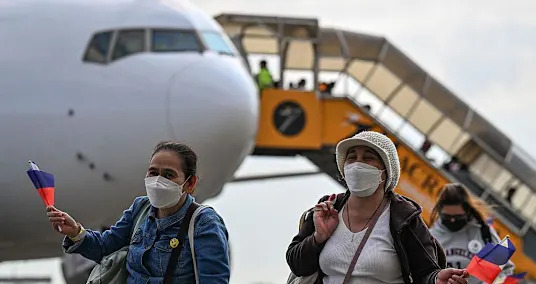
All Norma Tactacon can do is pray as the sirens blare.
The 49-year-old, who works in the Middle East as a domestic worker, is thousands of miles away from her home in the Philippines, where her husband and three children live.
Stuck in Qatar, which is caught in the crossfire of the US and Israel's war on Iran, her only hope is that she makes it home to her family.
"I get scared and nervous every time I see pictures and videos of missiles in the air," she tells the BBC. "I need to be alive to be there for my family. I'm all that they have."
As wealthy Gulf states turned into targets of Iranian strikes because of the US military bases they host, expats left in large numbers, while tourists and travellers have stayed away.
But it has been especially hard for the millions of migrants whose futures have now turned uncertain. From domestic help to construction workers, they have long supported these economies to lift their families back home from poverty.
Tactacon had hoped to pay for her 23-year-old son to graduate from a police academy and for her two daughters, aged 22 and 24, to become nurses, a springboard for high-paying jobs overseas.
That's why she spent a good part of the last two decades working as a maid in Qatar, Saudi Arabia and the United Arab Emirates (UAE).
What is still keeping her there is her salary. Filipino domestic workers in the Middle East earn a minimum wage of $500 (£370) a month, roughly four to five times more than what they would make in a similar job back home.
"I hope the world will be peaceful again and things go back to the way they were. I pray that the war will stop," says Tactacon in Qatar.

But the war is making her reconsider. She might return home and start a small business with her husband. She has reason to be worried.
One of the first victims of the conflict was 32-year-old Filipina Mary Ann Veolasquez, who worked as a caregiver in Israel.
The Israeli embassy in Manila said she was injured while leading her patient to safety, after a ballistic missile struck her apartment in Tel Aviv.
According to the International Labour Organisation (ILO), the region hosts 24 million migrant workers, making it the world's top destination for overseas labour. Most of them come from Asia - India, Pakistan, Bangladesh, Sri Lanka, the Philippines and Indonesia. Many of these workers take low paid or precarious jobs, and have little access to things like healthcare, the ILO says.
At least 12 South Asian migrant workers have died so far as a result of the conflict, according to reports.
The war's mounting fatalities include Dibas Shrestha, a 29-year-old Nepali who worked as a security guard in Abu Dhabi. He died in an Iranian strike on 1 March.
"I tried to convince him to move back to Nepal, but he said he liked his job in Abu Dhabi, and that he had a good life," his uncle Ramesh told the BBC.
"We have many relatives who've moved to the Gulf for work, so we were very worried for all of them,"
When the war started, Shrestha assured his family it was safe. In a post on Facebook, he wrote that watching the news had made him "concerned" but he also felt, "The news sometimes presents exaggerated or misleading information".
His uncle said Shrestha had been saving up to rebuild his parents' home after it had been damaged in an earthquake in 2015 that killed hundreds.
"He was their only son," Ramesh added. "So kind, and very smart."

More than 120kms away, in Dubai, debris from an intercepted missile killed Ahmad Ali, a 55-year-old water tank supplier from Bangladesh.
His son, Abdul Haque, said he joined his father to work in the UAE but returned to Bangladesh before the war started. His father continued sending money home - $500 to $600 every month, which is a huge sum in the poor South Asia nation.
Ahmad died during Ramadan, and his son was told it happened in the evening, just as people were breaking their fast.
"He really liked the people in Dubai, he said they were welcoming, that it was a great place to live," Abdul told the BBC.
"I don't even think he knew the war was going on. He didn't read the news and didn't have a smartphone."
Abdul's his view of Dubai and the region has changed: "It's not safe now, nobody wants to lose a father."
Governments in Asia have been scrambling to bring migrant workers home.
But the threat of missile strikes has disrupted travel to and from Dubai, Abu Dhabi and Qatar. So people seeking to leave have had to take longer routes home.

The last repatriation flight saw 234 Filipino workers from Kuwait, Qatar, and Bahrain travel up to eight hours by land to Saudi Arabia, where 109 others were waiting to join them on a Philippine Airlines flight.
Close to 2,000 Filipino workers and their dependents were flown back to Manila as of 23 March, according to the government.
The Middle East is home to roughly half of the more than two million Filipinos working overseas, and their remittances account for 10% of the economy.
Remittances are just as crucial for Bangladesh - most of its 14 million migrant workers are in the Middle East.
Close to 500 Bangladeshi workers have been repatriated since the conflict started, and the government in Dhaka has arranged for at least two more flights home, departing from Bahrain.
For some leaving is not an option.
Su Su from Myanmar found a safe home in Dubai when she left behind a country gripped by a bloody civil war that has dragged on since 2021.
The 31-year-old, who works as an operations specialist for a real estate company, has been in Dubai for two years.
She says her current work-from-home set-up reminds her of Covid lockdowns - except when she hears the sirens. Then she needs to stay away from her window.
"I have an emergency bag prepared in case I have to evacuate... This is just a habit I got from Myanmar."
And yet, she says, "The feeling here is more calm. I believe at the end of the day, we will be fine".
Additional reporting by BBC Burmese and BBC Indonesian
latest_posts
- 1
 Artemis II's moonbound toilet is working again to astronauts' relief after overnight fix
 - 2Uncover the Manageable Fish Practices: Sea agreeable Feasting
- 3Farmers call for French blockades over cow disease cull
- 4NASA troubleshoots Artemis II toilet problem in otherwise smooth flight
- 5How on earth did 'Shark Tank' star Kevin O'Leary end up in 'Marty Supreme'? I'll let him explain.




- 23 Most Amusing Messages At any point Sent Among Youngsters and Their Folks
- The Best Web-based Courses for Ability Advancement
- How to watch 'A Charlie Brown Christmas' for free in 2025
- Defense Minister Katz finally condemns Jewish extremist violence against Palestinians
- What's going around right now? COVID, flu, stomach bug on the rise
- Meet the astronauts about to make history on flight around the moon
- Find the Insider facts of Compelling Systems administration: Building Associations for Progress
- Wisconsin judge sends Slender Man attacker back to mental health institution after group home escape
- Chicago reports first rabies-positive dog in 61 years. What we know.