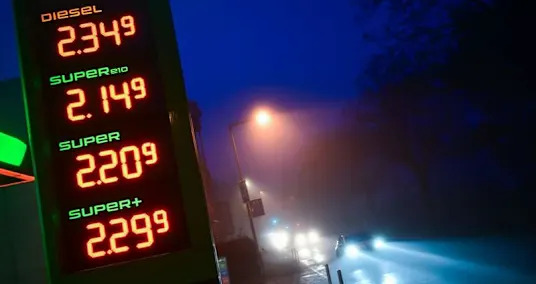

A new rule to limit fuel price hikes took effect in Germany on Wednesday, limiting petrol station to raising prices no more than once a day in a bid to bring down costs for motorists amid a surge in oil prices caused by the Iran war.
Under the new restrictions, petrol stations are only allowed to raise prices once at midday to limit price fluctuations and ensure greater transparency. Price reductions will still be allowed at any time.
Prices went up by as much as €0.2 ($0.23) per litre at noon (1000 GMT) but the hikes varied across petrol stations, as observed by dpa reporters.
A station in the northern outskirts of Berlin raised prices by between €0.06 and €0.08.
According to an analysis by motoring organization ADAC, 1 litre of Super E10 petrol was sold at an average of €2.175 across Germany shortly after noon, €0.076 more than shortly before noon.
The average price of diesel rose by €0.075 to €2.376, significantly higher than peak prices recorded on Tuesday morning.
The law was published in the Federal Law Gazette on Tuesday. In adopting the measure, the German government is following Austria, where a similar rule has been in place for some time and was recently tightened.
The ADAC and petrol station operators have expressed doubt that the new regulation will have a major effect.
Violations of the new rule can be punished with fines of up to €100,000 ($115,700). The "fuel measures package" also includes tougher antitrust rules. Germany's Federal Cartel Office will be given more powers to act against excessive prices.
Monika Schnitzer, a leading economist, warned against further intervention to bring down fuel prices, instead calling on drivers to cut down on trips.
Noting that the closure of the Strait of Hormuz has led to a shortage of oil, "people need to think about where it’s really essential to drive, where they can do without it, where they can carpool, and where they might be able to use public transport," she told public broadcaster ZDF.
Schnitzer, who is part of the German Council of Economic Experts, a five-member council also known as the "Five Sages" that advises the government on economic policy, also advocated for the current situation to be taken as an incentive to accelerate transition to renewables.
"We need to become less reliant on these fossil fuels," said Schnitzer. It was clear "that the best way out of this situation is to focus all our efforts on expanding renewable energy," she said.
latest_posts
- 1
 Step by step instructions to Guarantee the Life span of Your Dental Inserts: Support and Care Guide
 - 2New 'People We Meet on Vacation' trailer teases Poppy and Alex romance: Everything we know about the new Netflix movie
- 3Protest inspired by 'Gen Z' movement draws few young people in Mexico and many government critics
- 4Surveys of Thrillers That Re-imagined the Class
- 5Find Serenity: 10 Stunning Setting up camp Areas


- Barry Manilow reveals lung cancer diagnosis and plans to undergo surgery: 'It's pure luck' it was 'found so early'
- 75% of Arab Israelis support Arab party joining government coalition post-war, survey reveals
- Remain Cool and Solid: Top Summer Food sources for 2024
- NASA's SPHEREx telescope completes its 1st cosmic map of the entire sky and it's stunning!
- First Houthi launch toward Israel since war began triggers alerts across the Negev
- Birutė Galdikas: The last of the ‘angels’ in primatology’s most extraordinary chapter
- Parents who delay baby's first vaccines also likely to skip measles shots
- Figure out how to Separate Among Fledgling and Master Fender bender Legal counselors
- When faith comes under fire: How Iran’s repression of religious minorities has increased