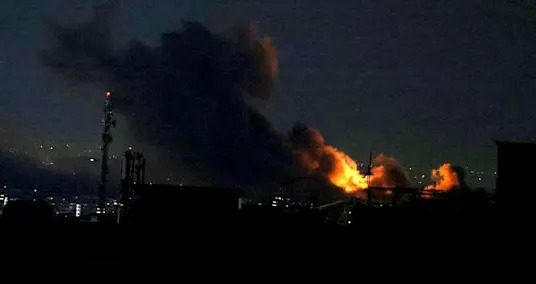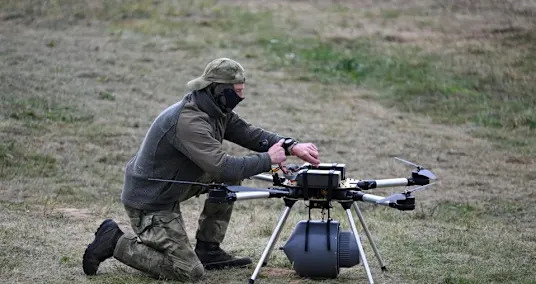
Last week, PBS reported that Russia had intensified its missile and drone attacks on Ukraine. Nearly 400 long-range drones and dozens of missiles had targeted civilian areas across Ukraine. The incident resulted in the deaths of at least six Ukrainian civilians, and more than 46 individuals were injured.
Following the missile and drone strike on March 24, Ukrainian President Volodymyr Zelenskyy warned that the Russian Federation would increase these attacks on Ukraine by building new long-range bases in Belarus. Zelenskyy explained on his X account that Ukrainian authorities spoke with Ukrainian partners about Russian drone attacks and Russia’s relationship with Belarus. Additionally, the Ukrainian president argued that Belarus is “becoming more involved in Russia’s war," and that the Europeans should be on alert.
According to a Reuters report, Russia plans to build four ground control stations for long-range drones in Belarus. Zelenskyy added that Ukrainian intelligence had discovered that “Russia intends to continue using the territory of Belarus and temporarily occupied territory of Ukraine to build ground control stations for long-range drones.”
Should Russia establish these drone capabilities in Belarus, it would not be the first time these two countries have cooperated and collaborated during Russia’s full-scale invasion of Ukraine. Since the military incursion began in February 2022, Belarusian President Aliaksandr Lukashenka has welcomed Russian President Vladimir Putin and Russian forces into Belarus. When the full-scale war initially began, the Belarusian government allowed the Russians to conduct missile strikes on Ukraine from Belarusian territory. Belarus was also used as a staging ground for Russian forces, where Russian soldiers and equipment were transported from Russia into Belarus so that they could then invade northern Ukraine.
As the war has progressed, however, Russia has reduced its physical presence in Belarusian territory. Nonetheless, Putin sees Lukashenka as an important ally, and the Russian president has sought to coerce his Belarusian counterpart into providing greater assistance to the Russian Federation.
While the Belarusian government has not sent Belarusian soldiers to fight in Ukraine, Belarus and Russia have conducted several military training exercises. These activities have helped the Russian military stay sharp and ready before various Russian battalions are sent to fight in Ukraine. Additionally, the Russian Federation has deployed intermediate-range ballistic missiles, known as Oreshniks, in Belarus. Lukashenka argued that the missiles were acquired to strengthen Belarusian national security and defense, but assessments by the Institute for the Study of War and the International Strategy Action Network for Security have found that Russia is increasing its military presence in Belarus, thereby drawing the two countries closer together.
Now, as Russia seeks to build bases in Belarus for long-range drones, Ukrainian authorities fear that this would give the Russians greater access to conduct strikes on Ukrainian territory. Moscow is approximately 1,500 kilometers from Kyiv, which gives Ukrainian authorities time to prepare for these attacks. It also gives Ukrainian defenses time to protect their citizens before the drones and missiles reach Ukraine. Minsk, however, is only 440 kilometers away from Kyiv. If Russia builds these bases in Belarus to send long-range drones to attack Ukraine, this would significantly reduce Ukraine’s response time to defend against the strikes. This could lead to deadlier Russian attacks on Ukrainian infrastructure and Ukrainian civilians. It could also result in additional Russian drones entering the airspace of NATO countries bordering Ukraine, such as Poland and Romania, thus putting NATO on alert. (During Russia’s ongoing invasion of Ukraine, Poland and Romania reported in 2025 that Russian drones had entered their airspace.)
Constructing these Russian bases for long-range drones in Belarus would take time, suggesting that Ukraine can prepare its air defenses accordingly before these ground control stations are completed. Nonetheless, the possibility of such installations in Belarus has put Ukrainian authorities on high alert. NATO members in Central and Eastern Europe, such as Poland, Romania, and the Baltic states, will also be monitoring the situation closely in Belarus should Russia construct the drone bases. As they wait to see what happens next, these countries will factor in their air defenses as they anxiously monitor Russia’s growing relationship with Belarus.
This article was originally published on Forbes.com
latest_posts
- 1
 Watch India launch advanced military satellite on rocket's 1st flight since May 2025 failure
 - 2Carrefour becomes first European retailer to offer shopping on ChatGPT
- 3Former IRGC child executioner tells ‘Post’ how he became devout Christian dissident
- 4Israeli forces kill one person in series of attacks on southern Lebanon
- 5Cuba says 33 have died of mosquito-borne illnesses as epidemic rages





- IDF drops over 80 explosives on Tehran weapon production sites in latest strike
- ‘And then we saw the little head.’ Scientists witness rare sperm whale birth
- 9 Under-The-Radar Malaysian Islands To Consider Instead Of Thailand Or Indonesia
- Sea level doesn’t rise at the same rate everywhere – we mapped where Antarctica’s ice melt would have the biggest impact
- Historic underwater structure discovered by divers off French coast
- Winter storm warnings issued across Northeast as up to 9 inches of snow forecast; deadly atmospheric river in California snarls travel
- UB professor shares his experience on almost becoming an astronaut
- Vaccine exemptions for religious or personal beliefs are rising across the U.S.
- IndiGo lands IATA chief Willie Walsh as new CEO