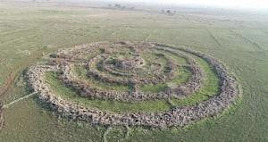

The newly discovered sites all share a similar design: large circular structures, between approximately 50 to 250 meters in diameter, built with stones taken from local basalt fields.
The stone circles of Rujm el-Hiri, nicknamed “Israel’s Stonehenge” or “Gilgal Refaim,” are not the only ones of its kind, according to a new study by Ben-Gurion University of the Negev (BGU) researchers.
By using advanced satellite imagery and remote sensing technology to survey areas previously inaccessible, BGU researchers have identified at least 28 other sites within 25 kilometers of Rujm el-Hiri that were not previously known.
The findings, recently published journal PLOS One, suggest that Rujm el-Hiri was not a singular, isolated monument, but rather an “elaborate example of a widespread architectural tradition integrated into the social and economic systems of the proto-historic Levant.”
Rujm el-Hiri was first discovered in the Golan Heights in 1968, and has been dated to approximately 3,500 and 6,500 years ago. It is made of a central cairn encircled by multiple concentric basalt stone rings, spanning for over 150 meters in diameter.
Satellite imagery revealed that the newly discovered sites share a similar design: large circular structures, between approximately 50 to 250 meters in diameter, built with stones taken from local basalt fieldstones.

Site part of a broader social, economic system
The discovered structures contain circular walls and internal partitions, often located near seasonal water sources and integrated into agricultural land use, revealing how ancient populations managed their resources and moved across the area.
Further, researchers believe the stone circles may have been multi-purpose, serving as ritual gathering places, territorial markers, or assembly sites for ancient herding communities, adding to earlier theories of Rujm el-Hiri being a burial site or astronomical observatory.
According to Dr. Michal Birkenfeld of BGU’s Department of Archaeology, the circles “invite a reinterpretation of significant proto-historic monuments in the region, recognizing them as integral parts of broader social and economic systems.”
"Our analysis may have implications for previous interpretations of Rujm el-Hiri's function," she concluded. "While traditional archaeological methods remain essential, this landscape-based perspective allows us to reach a fuller understanding of these monuments within our shared human past."
latest_posts
- 1
 'No Kings' protests live updates: More than 8 million turned out across all 50 states, organizers say
 - 2FDA adds strongest warning to Sarepta gene therapy linked to 2 patient deaths
- 3New funding transforms lives by expanding electricity access across Africa
- 4What is Fusarium graminearum, the fungus a Chinese scientist pleaded guilty to smuggling into the US?
- 5Ancient Egyptian pharaoh's boat is being reassembled in public at the Grand Egyptian Museum





- If someone's always late, is it time blindness, or are they just being rude?
- Instructions to Grasp the Innovation Behind 5G Pinnacles\
- The Electric Bicycle Americans Can Confide in 2024
- The Fate of Mechanical technology: 5 Headways Forming Tomorrow
- Surging measles cases are 'fire alarm' warning that other diseases could be next
- Computerized Moderation: Tracking down Equilibrium in the Advanced Age
- 10 Picturesque Campgrounds That Will Raise Your Outside Involvement with American
- Fundamental Home Exercise center Hardware: Amplify Your Exercises
- Israel faces tough choices over haredi draft exemptions, legal expert warns