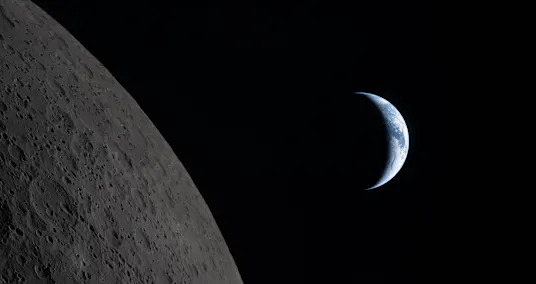
NASA has released the first images taken by the Artemis II crew during their historic trip around the far side of the moon.
The four astronauts — NASA commander Reid Wiseman, pilot Victor Glover, mission specialist Christina Koch and Canadian Space Agency mission specialist Jeremy Hansen — spent Monday’s seven-hour lunar flyby taking photos and making observations from the Orion spacecraft, which they named Integrity.
Among the stunning new images uploaded by NASA on Tuesday was a photo of “Earthset,” which was captured through the Orion capsule’s window at 6:41 p.m. ET, according to NASA.
"A muted blue Earth with bright white clouds sets behind the cratered lunar surface," the photo caption reads. "The dark portion of Earth is experiencing nighttime. On Earth’s day side, swirling clouds are visible over the Australia and Oceania region.”
Visible in the foreground is the moon, with the Ohm crater’s “terraced edges and a flat floor interrupted by central peaks,” per NASA’s description.

The crew also captured “Earthrise,” recreating the iconic photo taken during the Apollo 8 mission in 1968.

Also included in the new batch of images is a view of the solar eclipse that the crew experienced near the end of the flyby.

The astronauts donned eclipse viewers to protect their eyes during the nearly hour-long celestial event. But they still struggled to put into words what they were witnessing.

“Humans probably have not evolved to see what we're seeing," Glover told mission control. "It is truly hard to describe.”

Other photos captured close-up views of the lunar surface, including little-seen craters and basins from the vantage point of the crew, which at one point came within about 4,000 miles of the moon.
During Monday’s flyby, the Artemis II set a new record for the farthest distance from Earth traveled by humans — 252,756 miles, surpassing the previous mark set by Apollo 13 in 1970.


latest_posts
- 1
 Flourishing in a Cutthroat Work Market: Vocation Methodologies
 - 2How did I get my own unique set of fingerprints?
- 3Figure out how to Detect the Best Rooftop Substitution Choices
- 4Twins were the norm for our ancient primate ancestors − one baby at a time had evolutionary advantages
- 5Before Cheap Cars Were Common, This Fiat Changed Everyday Life for Millions



- Ariana Grande to host 'Saturday Night Live' Christmas show with Cher as musical guest, returning after nearly 40 years
- Israel Police arrest twenty-one as anti-war protests grow despite broad support for Iran war
- German gas price bill signed into law, but consumers not impressed
- New heart disease calculator predicts 30-year risk for young adults
- Fireball sightings are surging across the US — here's what's really going on
- How to get tickets to Jay-Z’s sold out Yankee Stadium shows
- IDF destroys regime's missile, sea mine production site in Yazd amid nationwide airstrikes
- Arctic sea ice hits lowest winter level as unprecedented heat hits smashes records all over Earth
- Germany's Merz under fire in Brazil for his comments on Amazon host city of COP30